> For the complete documentation index, see [llms.txt](https://academy.any2info.com/any2info-academy/llms.txt). Markdown versions of documentation pages are available by appending `.md` to page URLs; this page is available as [Markdown](https://academy.any2info.com/any2info-academy/no-code-platform/app-studio/app-logic/forms/data-parameters.md).
# Parameters
**Category**: App Studio
**Version**: 1.0
**Last Updated**: March 2, 2026
**Author**: Any2Info
### Description
The **Parameters** tab in the property menu of Dashboards and Forms allows configuration of:
* Incoming Parameters
* Fixed Filters
Together, these mechanisms provide controlled data filtering at the dataclip level.
Incoming Parameters define filterable inputs for specific dataclips.\
Fixed Filters assign values to those parameters automatically.
All filtering logic is applied using **AND** conditions.
***
## Incoming Parameters
### Description
An Incoming Parameter defines a filter input for a specific:
* Dataclip
* Header (field) within that dataclip
It allows external or internal processes to inject a value that filters the dataclip’s data.
Each parameter is strictly bound to **one dataclip and one header**.
***
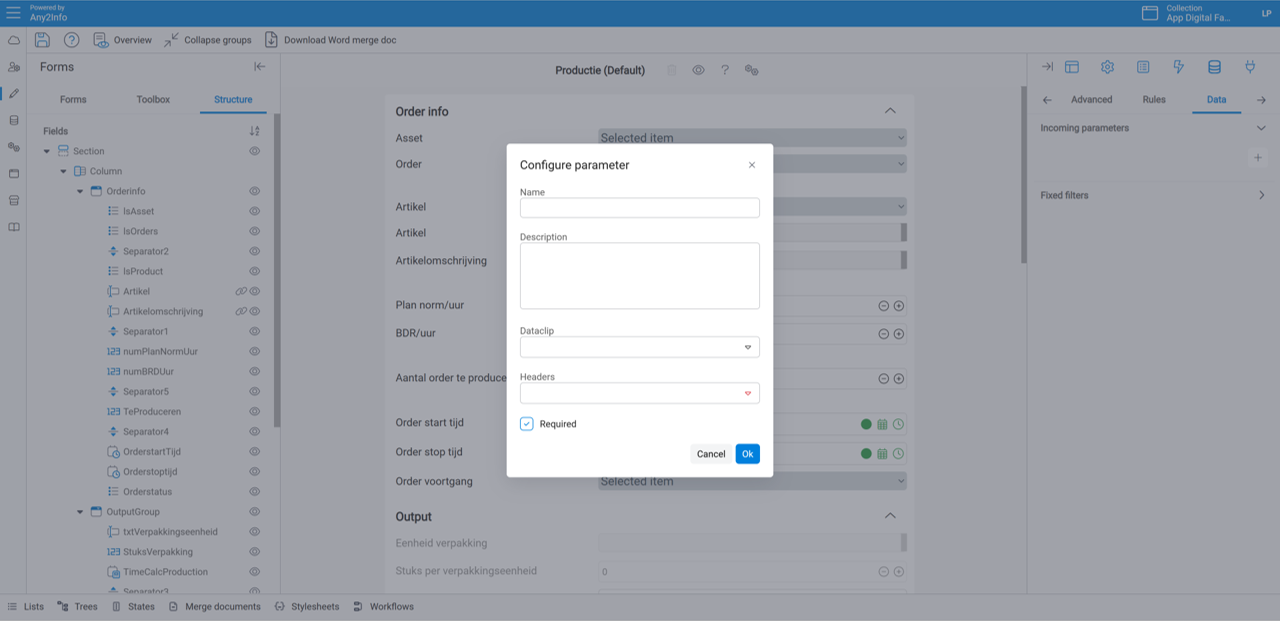
### Configuration Options
| Setting | Required | Description |
| ----------- | -------- | --------------------------------------------------------------------- |
| Name | Yes | Recognizable identifier of the parameter. |
| Description | No | Informational description used for management purposes. |
| Dataclip | Yes | The dataclip to which the parameter applies. |
| Header | Yes | The specific header (field) within the selected dataclip. |
| Required | No | If enabled, data will not load unless the parameter receives a value. |
***
### Type Handling
The parameter type is implicitly determined by the selected header type.
Examples:
* Numeric header → Numeric parameter
* Date header → Date parameter
* Text header → Text parameter
Type validation follows the dataclip header definition.
***
### Behavior
* A parameter applies only to its configured dataclip.
* Multiple parameters can target the same dataclip.
* When multiple parameters apply to the same dataclip, they are combined using **AND** logic.
Example: CustomerId = 5 AND Status = 'Open'
***
### Required Flag
When **Required** is enabled:
* The dataclip will not load data if the parameter is not set.
* A message or logging entry indicates the missing parameter.
* This is recommended when working with sensitive data.
***
### Value Sources
Incoming parameters can receive values from:
* Fixed Filters
* Navigation flows (documented separately)
***
### Security Considerations
Use the **Required** flag when exposing sensitive datasets to prevent unintended data exposure.
***
## Fixed Filters
### Description
A Fixed Filter assigns a value to an Incoming Parameter automatically.
It is not a direct data filter. Instead, it functions as a controlled parameter injector.
Fixed Filters are configured per Dashboard or Form in the **Parameters** tab.
***
### Configuration Options
| Setting | Required | Description |
| ------------------- | -------- | ---------------------------------------------------- |
| Incoming Parameter | Yes | The parameter to which the value will be assigned. |
| Type | Yes | Determines how the parameter value is generated. |
| Additional Settings | Depends | Additional configuration depending on selected type. |
***
### Supported Types
#### Static
Assigns a fixed value.
Additional configuration:
* Value (must match parameter/header type)
Use case:
* Hardcoded filtering (e.g., Status = Active)
***
#### User
Assigns the signed-in user's **User ID**.
No additional configuration required.
Use case:
* Restrict data to records owned by the logged-in user.
***
#### Username
Assigns the signed-in user's **Username**.
No additional configuration required.
Use case:
* Filtering by username-based ownership.
***
#### Variable
Assigns a value from a **user-specific variable**.
Additional configuration:
* Target variable selection
Note: If the selected variable allows user modification, the resulting filter may indirectly change based on user input.
***
### Visibility & Editability
* Fixed Filters are not explicitly visible to end users.
* They are visible in logging only.
* End users cannot edit Fixed Filters.
* Variable-based filters may indirectly change if the variable itself is user-editable.
***
### Execution Flow
1. Fixed Filters assign values to Incoming Parameters.
2. Incoming Parameters bind values to a specific Dataclip/Header.
3. Dataclip applies all parameter filters using **AND** logic.
4. Data is retrieved accordingly.
***
### Logical Behavior
All parameter filters are combined using **AND** conditions.
Example: UserId = 12 AND Department = 'Sales'
***
### Best Practices
* Use **Required** for sensitive datasets.
* Use **User** type filters for row-level security.
* Avoid multiple parameters targeting the same header.
* Use Variables carefully when allowing user-editable values.
* Logically separate system-driven filters (Fixed) from navigation-driven parameters.
***
### Changelog
| Version | Date | Change |
| ------- | ------------- | ------------------------------------ |
| 1.0 | March 2, 2026 | Initial documentation version added. |
---
# Agent Instructions
This documentation is published with GitBook. GitBook is the documentation platform designed so that both humans and AI agents can read, navigate, and reason over technical content effectively. Learn more at gitbook.com.
## Querying This Documentation
If you need additional information that is not directly available in this page, you can query the documentation by asking a question.
Perform an HTTP GET request on the following URL with the `ask` and `goal` query parameters:
```
GET https://academy.any2info.com/any2info-academy/no-code-platform/app-studio/app-logic/forms/data-parameters.md?ask=&goal=
```
`ask` is the immediate question: it should be specific, self-contained, and written in natural language.
`goal` is what the user is ultimately trying to achieve, the reason they need the answer. Sharing it helps GitBook give you a better, more relevant answer. A goal is most helpful when it describes the outcome the user wants rather than restating the question. For example, with `ask=how do I create an API token`, a goal like `automate deployments from our CI pipeline` lets GitBook tailor the answer to that use case.
The response will contain a direct answer to the question and relevant excerpts and sources from the documentation.
Use this mechanism when the answer is not explicitly present in the current page, you need clarification or additional context, or you want to retrieve related documentation sections.